

Politics and Economy in Iceland
Iceland is a parliamentary representative democratic republic, whereby the Prime Minister is the head of its government. The modern parliament "Alþingi" was founded in 1845 and it was seen as a re-establishment of the assembly founded in 930 in the Commonwealth period. Currently the icelandic parliament has 63 members.
In history, Iceland was an under-developed society based on agriculture. In the 19th century fishing became much more prosperous. During the political movement of independence, the bank of nation was founded in 1855. By taking credits, the fishing fleet could be modernised and in the early 20th century a first economic boom started. But not until the middle of the century people joined much affluence. After its independence in 1944 Iceland’s fishing zone has been enlarged from 3 to 200 sea miles. The fishing industry developed to Iceland’s most important industrial sector during the 20th century.
But an economy based on only one economic sector often is subjected to strong economic fluctuations. That’s why the country’s government is still trying to bring forward other branches, particularly such as power industry or tourism. The tourism industry became of a great importance during the last 60 years. In 1950 only 4.000 tourists visited Iceland. Today more than 300,000 visitors come to the North Atlantic island per year.
Below you find some basic facts about politics and the economy of Iceland:
Name: Republic of Iceland (icelandic: Lýðveldið Ísland)
Population: 383,726 (Last update: 01.01.2024)
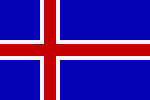
Ensign: Red cross with white border on a blue background.
Country code (ISO): IS
Capital: Reykjavík, 23 districts 135,714 inhabitants
Currency: Icelandic króna (ISK) = 100 Aurar (Get more information on the icelandic currency here)
Official language: Icelandic
National holiday: 17th June
Political system: Constitutional republic
Legislative body: Althing (parliament)
Executive authority: Cabinet
Judiciary: Supreme Court
The biggest political parties: Independance Party, Progress Party, Social democratics, The Greens
Parliamentary elections: each four years
Electoral law: Citizens of 18 years or older
President:: Guðni Thorlacius Jóhannesson
Prime Minister: Bjarni Benediktsson
Military: without armed forces
Membership in several international organisations, such as:
- United Nations
- European Free Trade Association (EFTA)
- European Economic Association (EEA)
- North Atlantic Treaty Organisation (NATO)
- Organisation for Economic Cooperation and Development (OECD)
- International Monetary Fund (IMF)
- Council of Europe
- Nordic Council
- Council of the Baltic Sea States
- others
Gross Domestic Product (GDP): 2.554.565 Mio. ISK (+3,60 %)
GDP per capita: 7
More information on the Icelandic politics and the parliament you'll find on the web pages of the Althingi: www.althing.is